
NCC 2025 - Feasibility Impact on Apartment Developments
A Proposed Change to AS1668.2 (2024) Could Significantly Impact Apartment Design
Rising material costs and labour shortages are reducing project feasibility, constraining new housing and worsening Australia’s housing supply.
A proposed change in AS1668.2 (2024), expected to be referenced in the National Construction Code, may unintentionally add further complexity and cost to apartment developments.
The issue relates to a clause that changes how exhaust air from apartments is assessed. While the intent of the change is technically understandable, the way it interacts with typical apartment building design could have significant real-world consequences.
What the clause changes
The updated standard proposes that exhaust outlets located within a six-metre radius are treated as a single combined discharge.
The total airflow from these outlets then determines the separation distance required from windows, doors, balconies and other openings.
In stacked apartment buildings, exhaust outlets from apartments above and below typically fall within this six-metre radius. When these flows are combined, the required separation distances increase significantly.
For many apartment layouts, this makes local façade discharge extremely difficult to achieve.
Why this becomes a problem in residential buildings
Apartment buildings have limited façade available to each dwelling.
Most apartments only have one external wall or balcony, and that façade is already constrained by windows, doors, balustrades and architectural requirements.
When the combined airflow rules are applied, with the exception of large penthouses or corner apartments, there is often not enough façade length to achieve the required separation distances, particularly in one- and two-bedroom apartments.
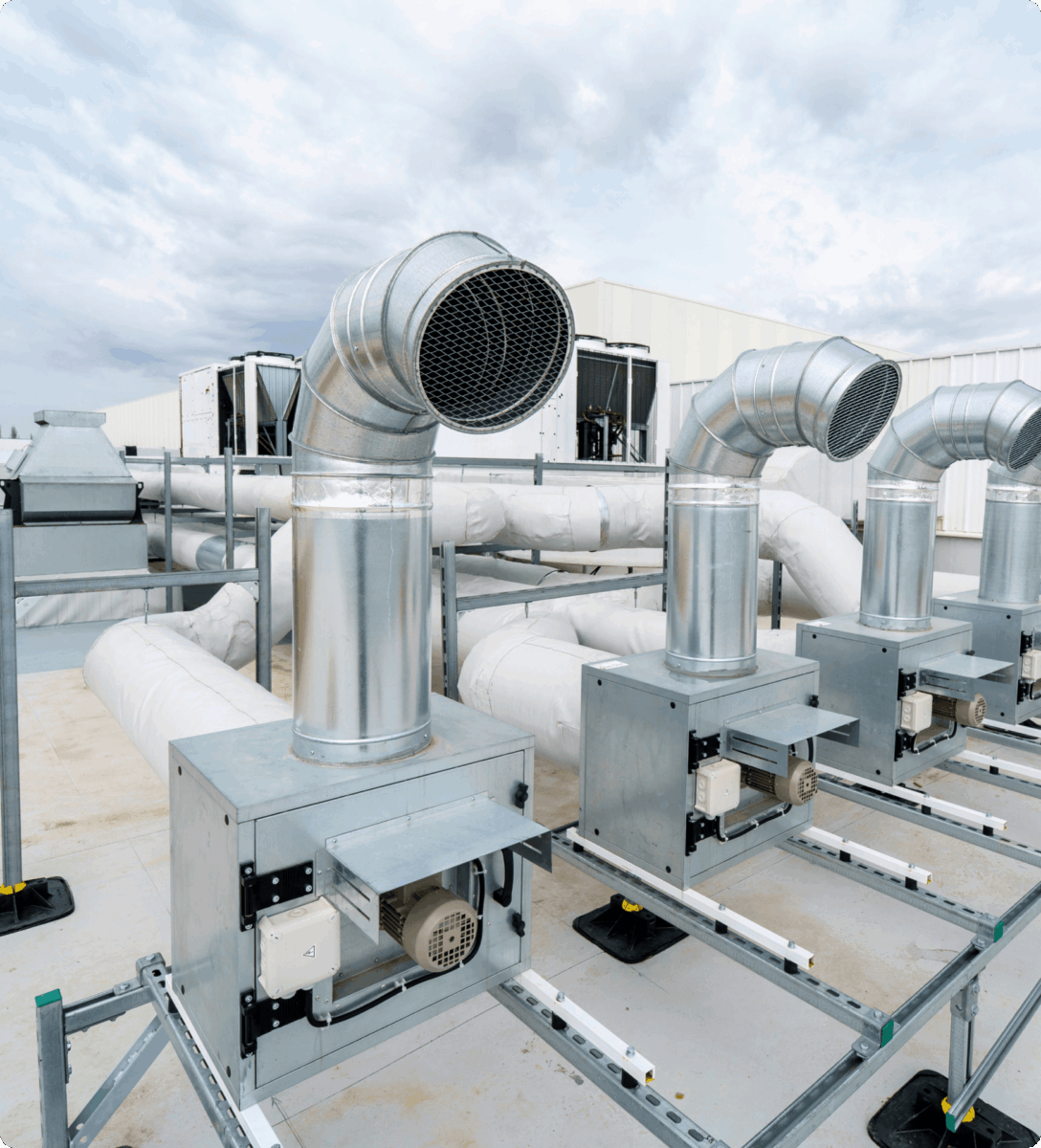
As a result, designers are often forced to move exhaust air out of the apartment entirely and connect multiple dwellings into centralised exhaust systems discharging at roof level.
Centralised systems introduce a number of consequences for apartment developments.
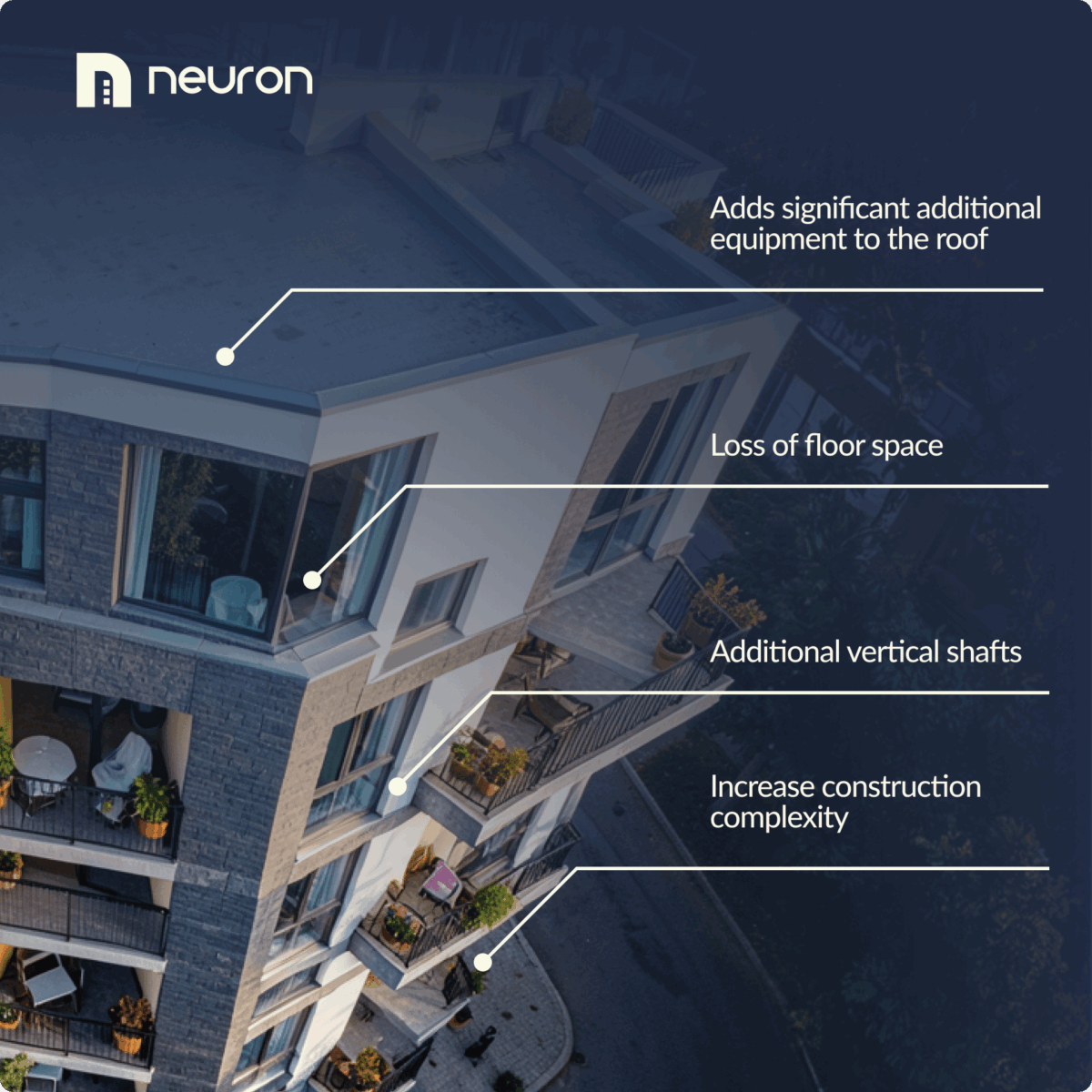
Additional vertical shafts must run through the building to carry exhaust air to the roof. These shafts take up valuable space and increase construction complexity.
This leads to:

Increased construction costs from additional ductwork, fans and fire-rated shafts

Loss of internal floor area to shared services risers

Higher long-term maintenance and operational costs for strata

Reduced system resilience where failures affect multiple apartments
Industry modelling suggests the combined impact could add approximately $13000–$48000 to the purchase price of an apartment where these constraints apply.
In tall buildings the impact can be even more pronounced, as shafts grow larger and extend through many levels. In particular, shafts running through sub-penthouse and penthouse levels can significantly constrain interior design, limiting the ability to maximise value from what are typically the highest-margin apartments within a development.
In addition, this type of system adds significant additional equipment to the roof. With many projects pursuing activated communal roofs, this would have a significant impact on the viability of such an arrangement.
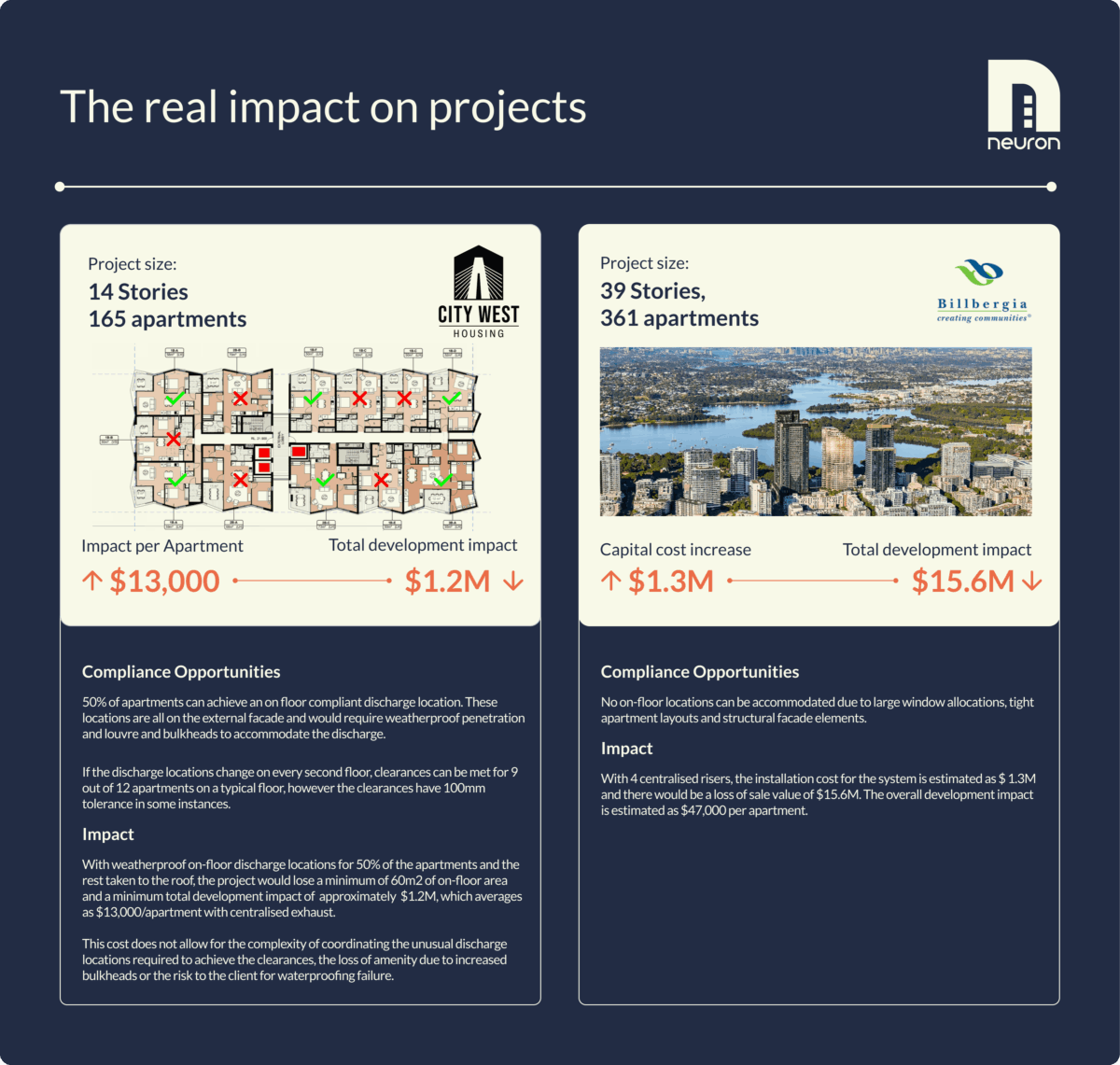
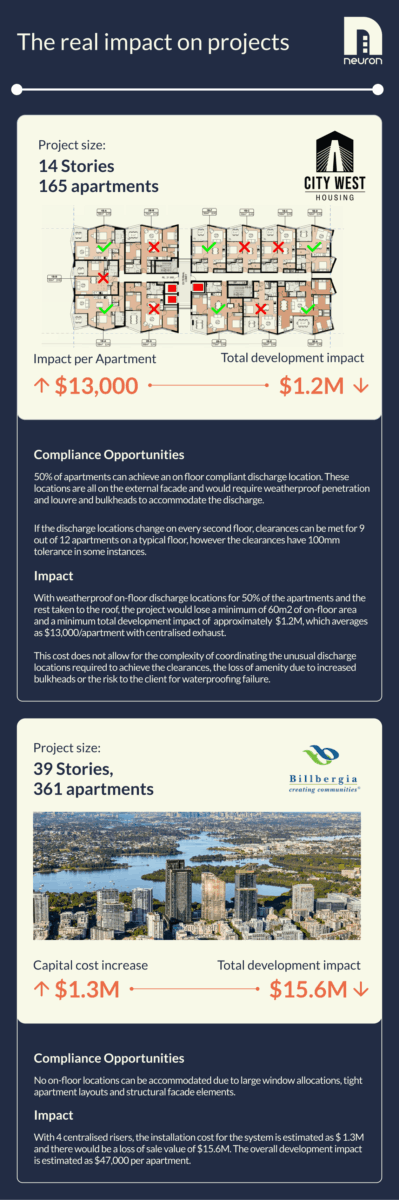
These assessments have been done assuming the following:
- A kitchen exhaust flowrate of 100 l/s, which is at the bottom end of performance for ducted domestic rangehoods.
- Bathrooms are exhausted at 25 l/s, which is the minimum required for compliance. This is usually exceeded by designers to align with 10l/s.m² (~40-60 l/s) to provide improved clearance of humidity and condensation.
- Laundry exhaust at 40 l/s
The gap between theory and real buildings
The standard technically still allows façade discharge where separation distances are met.
However, this assumes buildings have sufficient façade length to distribute exhaust outlets. In reality, most apartments simply do not.
This creates a gap between what is technically permissible in the standard and what is practically achievable in real residential buildings.
On the projects we have tested, this effectively makes a consistent building-wide solution impossible.
In the cases where solutions can be found, they often eliminate key strategies the industry is using to help reduce the cost of housing, such as:
- Standardised apartment layouts
- Vertically stacked unit planning
- Avoiding transfer slabs
- Maintaining consistent wet-area stacking
- Minimising slab-to-slab heights
- Using standardised façade modules
These strategies are widely used to improve project feasibility and help deliver more affordable housing outcomes.
To stay informed with the latest news from Neuron
Why industry awareness is important
Ventilation standards intend to improve building performance and occupant health. In this case, the change aims to improve air quality for occupants using external balconies.
However, regulatory changes must also reflect how buildings are actually designed and delivered.
While the vast majority of other AS 1668.2 (2024) changes are supported by us at Neuron, we believe this clause, as currently written, will unintentionally increase costs and create significant uncertainty across the industry around how to comply with it, particularly where designers attempt to avoid centralised exhaust systems.
What happens next
The key is identifying impacts like this early.
When regulatory or technical changes are understood early enough, project teams have more room to respond — whether that means adjusting layouts, reviewing servicing strategy, protecting saleable area or avoiding unnecessary redesign later.
In that sense, the solution is not just compliance. It is getting the right engineering and feasibility insight early enough to understand what a change like this will actually do to a project.
If you are involved in the living sector from a design, development, construction or policy perspective, we encourage you to share this information within your networks and help ensure relevant industry bodies and policymakers understand the practical implications of this clause. The Neuron team has been engaging with both federal and state government bodies to highlight these concerns. However, as of today, the clause is still expected to be adopted in the upcoming NCC in its current form.
We are supportive of improvements to building standards and the adoption of the updated NCC. However, this specific clause in AS1668.2 (2024) should be reviewed and amended to better reflect how apartment buildings actually work.
What happens next
The key is identifying impacts like this early.
When regulatory or technical changes are understood early enough, project teams have more room to respond — whether that means adjusting layouts, reviewing servicing strategy, protecting saleable area or avoiding unnecessary redesign later.
In that sense, the solution is not just compliance. It is getting the right engineering and feasibility insight early enough to understand what a change like this will actually do to a project.
If you are involved in the living sector from a design, development, construction or policy perspective, we encourage you to share this information within your networks and help ensure relevant industry bodies and policymakers understand the practical implications of this clause. The Neuron team has been engaging with both federal and state government bodies to highlight these concerns. However, as of today, the clause is still expected to be adopted in the upcoming NCC in its current form.
We are supportive of improvements to building standards and the adoption of the updated NCC. However, this specific clause in AS1668.2 (2024) should be reviewed and amended to better reflect how apartment buildings actually work.